How to read a textile spec sheet: GSM and construction
Four things on a supplier spec sheet tell you most of what you need to know about a garment: the weight in GSM, combed or carded cotton, tubular or cut-and-sewn construction, and how the hems and shoulders are finished. Everything else is detail.
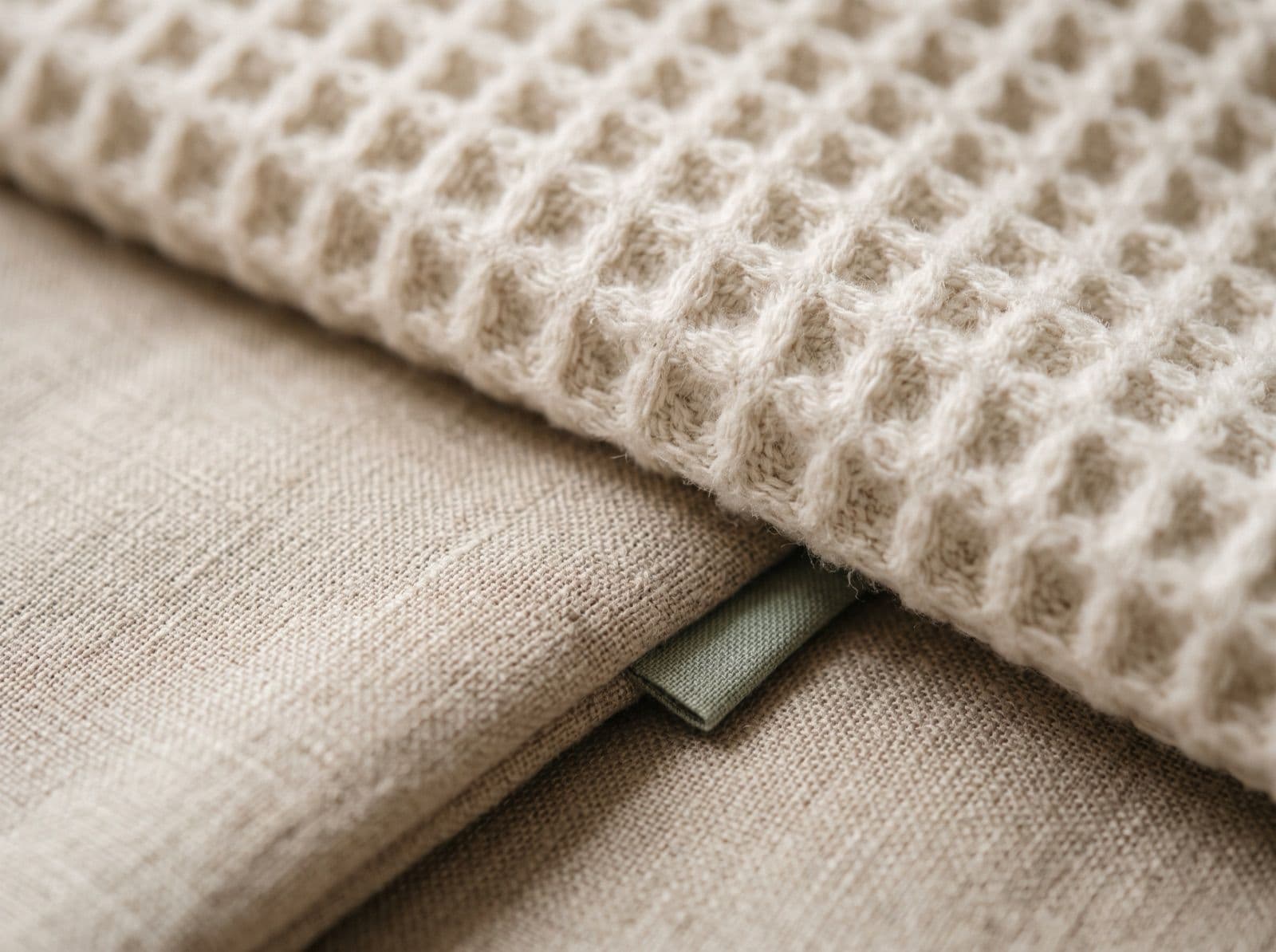
Short answer: Four things on a supplier spec sheet tell you most of what you need to know about a garment: the weight in GSM, whether the cotton is combed or carded, whether the body is tubular or cut-and-sewn, and how the hems and shoulders are finished. Everything else is detail. This guide explains what each term means and what it changes in practice.
Supplier catalogues describe garments in a compressed technical shorthand. “Single jersey, 150 gsm, tubular, 1x1 rib collar” is a complete description of a t-shirt to someone who reads it fluently, and close to meaningless to everyone else.
Learning to read it is worth the twenty minutes. It is the difference between choosing a garment from a photograph and choosing one from what it is.
GSM: the weight of the fabric
GSM stands for grams per square metre. It is the single most informative number on a spec sheet, because it correlates with thickness, opacity, drape and, to a degree, durability.
For cotton jersey garments, the ranges you will typically encounter:
| Weight | Character | Typical use |
|---|---|---|
| 130–150 gsm | Light, fluid, can be slightly translucent in pale colours | Summer tees, fashion-led fits, layering |
| 150–180 gsm | The standard mid-weight | General-purpose corporate t-shirts |
| 180–200 gsm | Substantial, holds shape | Workwear, heavier-duty use |
| 200–250 gsm | Heavyweight, structured | Oversize and streetwear-influenced fits |
| 250+ gsm | Sweatshirt territory | Fleece, hoodies |
Two things worth knowing about GSM.
Higher is not automatically better. A 220 gsm oversize t-shirt and a 145 gsm fitted one are different products for different situations, not a better and a worse one. In warm climates or for summer events, a heavy shirt is simply uncomfortable. The right weight follows from the use.
Weight interacts with colour. Light-weight fabric in white or pale tones can show through. If you are ordering a pale colourway at the lower end of the range, ask for a sample and check it against a shirt worn underneath, not against a table.
Combed versus carded cotton
Both terms describe how the raw cotton fibre is prepared before spinning.
Carded cotton is cleaned and the fibres aligned, but short fibres and remaining impurities are left in. It produces a slightly coarser, more textured yarn.
Combed cotton goes through an additional step in which the shorter fibres are removed and the remainder combed into closer alignment. The result is a smoother, more uniform yarn.
In practice, combed cotton is generally softer to the touch and produces a more even fabric surface, which also gives a cleaner print. Carded cotton has a rougher, more rustic character, which some heavyweight and streetwear-influenced garments use deliberately.
Neither is a quality verdict on its own. But if softness matters for the intended use, the spec sheet will tell you which one you are getting, and it is worth knowing which you asked for.
Tubular versus cut-and-sewn
This describes how the body of the garment is constructed, and it is one of the clearest indicators of the category a garment belongs to.
Tubular construction means the body is knitted as a continuous tube, with no seams at the sides. It is simpler and faster to produce. The trade-off is fit: a tube does not shape to the body, so tubular garments tend to hang straight.
Cut-and-sewn means the fabric is cut into panels and assembled with side seams. This allows the pattern to be shaped, so the garment follows the body rather than hanging off it. It also tends to hold its shape better through wear.
Spec sheets state this explicitly, in phrases such as “tubular construction” or “cut and sewn, side seams”. If a garment description mentions side seams, it is cut-and-sewn.
A note on oversize fits: dropped shoulders and a relaxed body are a pattern decision, independent of construction. A garment can be cut-and-sewn and still deliberately oversized.
Shoulder and seam reinforcement
The shoulder seam takes more stress than any other part of a t-shirt, and it is where cheap garments give up first.
Silicone or twill tape applied along the shoulder seam stabilises it and helps the shoulder line hold its shape through repeated wearing and washing. Spec sheets describe this as “shoulder seams reinforced with silicone tape”, “taped shoulders” or similar.
Hem finishing is described as single-stitch or double-stitch, sometimes “double needle”. Double stitching at the sleeve and body hems adds durability and gives a cleaner finish line. Single stitching is lighter and simpler.
Neither reinforcement makes a garment good on its own. Both are useful signals of where a manufacturer chose to spend, and their absence on an otherwise premium-positioned garment is worth a question.
Collar construction
Most cotton t-shirts use a 1x1 rib collar, meaning a ribbed knit with a one-stitch-up, one-stitch-down structure. Ribbing has natural elasticity, which is what allows a collar to stretch over the head and return.
The collar detail worth checking is the taped or bound neckline, often described as a “clean finish tape”, “herringbone tape” or “bande de propreté” in French-language catalogues. This is a strip of fabric covering the interior neck seam. It stops the seam rubbing against the neck and, more importantly for longevity, prevents the seam from stretching out.
A collar that goes soft and wavy after a few washes is usually an unreinforced one.
Labels and the personalisation question
This one is specific to branded merchandise, and it is easy to miss.
Some garments are supplied with a printed brand label at the neck. Others carry no brand label at all, only a small removable size tab, often described as a tear-away label.
For corporate merchandise, the second is significantly more useful. It means the garment can carry the client’s own neck label, or none at all, and the only name on the finished item is the one the client puts there. Garments intended for the promotional market are frequently designed this way, and the spec sheet will say so.
If you intend to add your own neck branding, check this before ordering. Removing a stitched-in brand label after the fact is not practical at volume.
Finishing treatments
Enzyme washing is a treatment applied after manufacture in which enzymes break down surface fibres. The effect is a softer hand-feel and a slightly worn, settled appearance from first wear. It is common on heavier cotton garments and fleece.
Low-shrinkage treatment, sometimes noted as LST on French-language spec sheets for terry fabrics, indicates the fabric has been processed to reduce dimensional change in washing. Relevant if you are ordering to a size curve and cannot afford surprises after the first laundry cycle.
Composition, and the colourway trap
Composition is stated as percentages: 100% cotton, 80% organic cotton / 20% recycled polyester, and so on.
The detail that catches people out is that composition frequently changes between colourways in the same product line. Heather, marl and melange colours are produced by blending fibres, so a range listed as 100% cotton may specify a different blend for its grey melange, and a range listed as 80/20 may be 75/25 in one particular shade.
Supplier sheets note this, usually in a parenthesis or a footnote. If you are communicating a composition figure, or relying on it for a certification claim, check it against the specific colourway you are ordering, not the headline figure for the range.
A checklist for reading any spec sheet
Four pieces of information are enough to size up a garment on a supplier spec sheet. Fabric weight first, in grams per square metre: 130 to 150 g/m² gives a light cloth, sometimes slightly sheer in pale shades; 150 to 180 g/m² is the versatile standard; 180 to 200 g/m² holds its shape under heavy use; above 250 g/m² you are into sweatshirt territory. Then the yarn, combed or carded cotton, which decides softness and how well print holds. Then the construction of the body, tubular or side-seamed, which decides the cut. Finally the finish of hems and shoulders, which decides how long the garment survives washing. Heavier is not automatically better: a well-cut 145 g/m² t-shirt can serve where a 220 g/m² one would be needlessly warm. The rest of the sheet is detail.
- Weight in GSM — does it match the intended use and climate?
- Composition — and does it hold for the colourway you are ordering?
- Combed or carded — does softness matter here?
- Tubular or cut-and-sewn — how should this sit on the body?
- Shoulder reinforcement — taped or not?
- Hem finish — single or double stitch?
- Neck finish — is the interior seam covered?
- Label — brand label, or removable size tab?
- Treatments — enzyme washed, low shrinkage?
- Care instructions — any colourway with special requirements?
Ten lines. Most of them are on the sheet already. Reading them takes a minute and removes most of the room for disappointment.
Frequently asked questions
What GSM should I choose for company t-shirts? For general-purpose corporate use in a temperate climate, the 150–180 gsm range is the usual compromise between substance and comfort. Lighter suits warm-weather events; heavier suits oversize fits and cooler conditions.
Does a higher GSM mean a more durable garment? Not directly. Weight and durability correlate loosely, but construction matters more. A well-constructed 150 gsm shirt with taped shoulders and double-stitched hems will typically outlast a heavier one without them.
Why does the same size fit differently across two references? Because fit is a pattern decision. Unisex, oversized, tubular and cut-and-sewn garments all sit differently on the same body. Never assume a size curve carries across references. Check the measurement table for each one.
What does “vegan” mean on a garment spec? It indicates the product contains no animal-derived materials, and in some certification schemes that no animal-derived substances were used in processing. It is a composition statement, not an environmental one.
Technical note on sources: the GSM ranges and construction descriptions in this article reflect established textile industry practice and standard supplier catalogue terminology. Where a specific figure matters for your order, take it from the spec sheet of the exact reference and colourway you are buying, and ask your supplier to confirm it in writing.
Last reviewed: August 2026.