Kick-off and seminar: which branded items to choose
For a kick-off or a seminar, choose items that are useful during the event and afterwards: notebook, pen, bottle, tote bag, and a piece of team clothing for longer formats. Formats, budget per participant, logistics at the venue and lead times: the method for ordering on time.
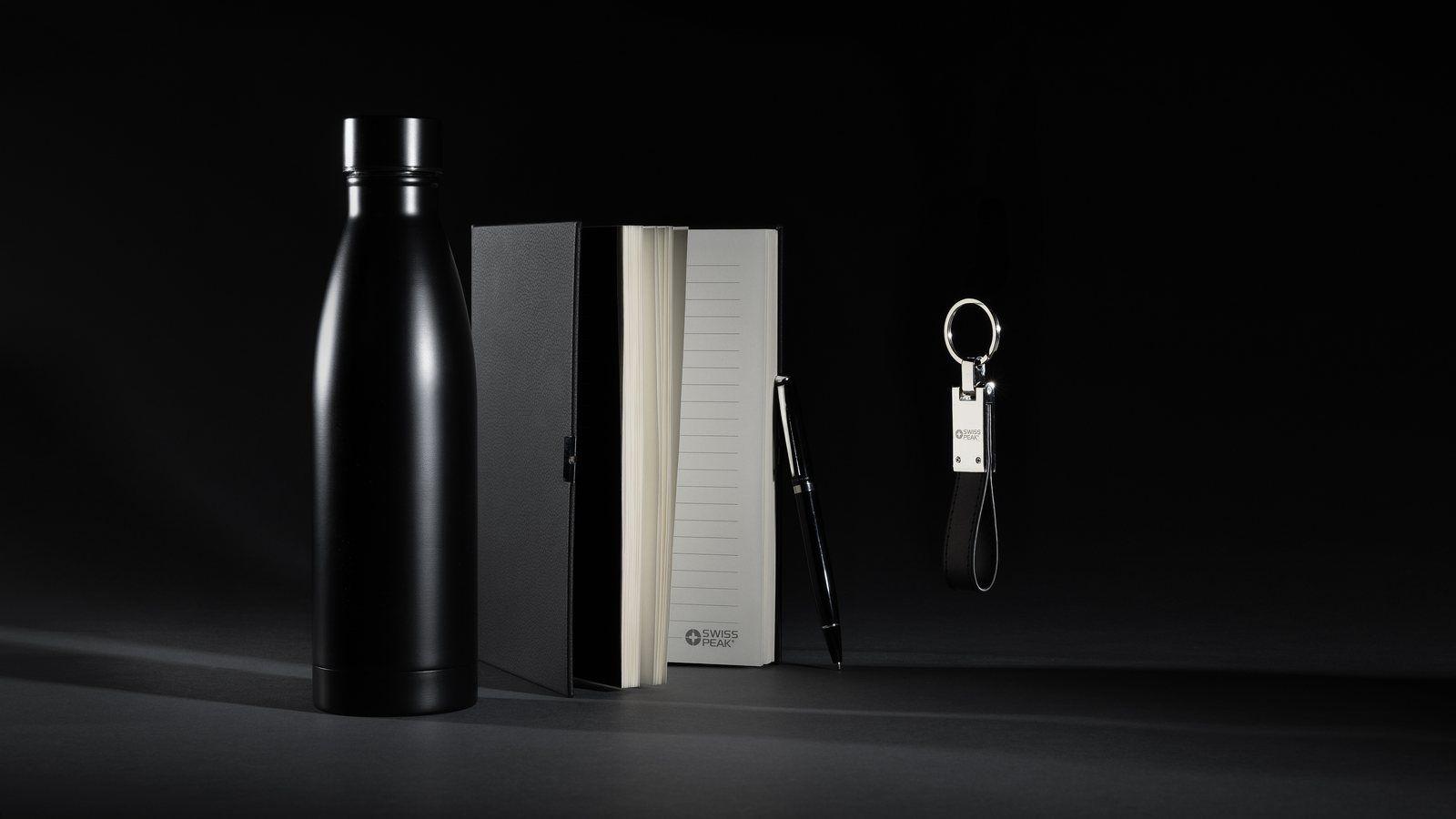
For a kick-off or a seminar, the items that work are the ones people use during the event and that stay useful afterwards: a notebook and a pen for the workshops, a bottle, a tote bag to carry everything, and for longer formats a piece of team clothing. Allow, as a rule, 12 to 25 working days of production after the mock-ups are approved: for a kick-off at the end of January, the project starts in November. This guide covers what to plan for each format, the budget per participant, logistics at the venue and the schedule.
Why plan items for a kick-off?
A kick-off is there to align teams on a direction: a strategy, an annual plan, a reorganisation. The items handed out that day carry the message beyond the day itself: the notebook in which the objectives were written down, the bottle that stays on the desk, the sweatshirt worn at the next team event. They also bring people from different sites and jobs together visually, and they are what appears in the photos shared after the event.
Usefulness matters more than impact. In ASI’s 2026 Ad Impressions Study (nearly 5,000 people surveyed in North America and Europe), 78% of people who keep a promotional item keep it because it is useful to them.
What to plan for each event format?
| Format | What is useful | Examples |
|---|---|---|
| Plenary session of 200 to 2,000 people | A simple kit, handed out at reception | tote bag, notebook, pen, lanyard and badge holder |
| Residential seminar of 1 to 3 days | Items for the workshops and for outdoors | quality notebook, insulated bottle, fleece or softshell, umbrella |
| Team workshop or offsite | Fewer items, better chosen | large notebook, metal pen, insulated bottle |
| Team building, sports day | Textiles first | technical T-shirt, sweatshirt, cap, bottle |
A few products to build the kit from:
- Peru cotton tote bag
- Spectrum Plus A5 hard cover notebook
- Moleskine L Capri notebook
- Darius aluminium pen
- Yogi lanyard
- Serge badge holder
- Cove 500 ml insulated bottle
- Roly Antartida softshell
- Roly Shanghai men’s technical T-shirt
- Roly Shanghai women’s technical T-shirt
- Halo 30-inch umbrella
What to avoid: gadgets nobody takes home, dated items if you want to reuse the surplus, and a logo that is too large on textiles, which will no longer be worn after the event.
How much to plan per participant?
As a guide, based on the prices in our catalogue, excluding branding:
| Kit | Contents | Order of magnitude excl. VAT per person |
|---|---|---|
| Plenary welcome | tote bag, pen, simple notebook, lanyard | €3 to €8 |
| Seminar | quality notebook, metal pen, insulated bottle | €15 to €60 |
| Seminar with textiles | the seminar kit + an embroidered fleece or softshell | €30 to €80 |
| Team building | T-shirt or sweatshirt, cap, bottle | €10 to €30 |
Branding comes on top of these amounts, and the unit price falls as the quantity rises. The quote gives the actual price.
A logo, or a theme?
Many companies give their kick-off a name or a slogan. Putting it on the items makes the event more memorable, but limits reuse: a “Kick-off 2027” notebook will not be used at the next event. A common solution: the logo alone on the long-lasting items (bottle, textiles), and the theme on what is made for the event (badge, notebook). On textiles, discreet branding, on the chest or the sleeve, is the kind people still wear afterwards.
How to organise logistics at the venue?
- Delivery. To your head office, then transport by your teams, or directly to the hotel or conference centre. In that case, ask the venue for the possible receiving date and the name of the on-site contact: many venues only accept parcels the day before.
- Sorting. One kit per participant, already assembled, or loose items to be shared out. For more than 200 people, the assembled kit saves the organising team half a day.
- Sizes. Add a “clothing size” question to the registration form. It is the simplest way to avoid surplus XXL and shortages in M.
- Surplus. Plan 5 to 10% extra for last-minute registrations and speakers. Without a dated theme, the surplus can then be used to welcome new employees: our guide to the employee welcome pack explains how to organise it over the year.
- Events abroad. We deliver in Belgium and throughout Europe: state the country and the venue when you request the quote; transport time is added to production time.
When to order?
Lead times depend on the product, its availability in stock and the branding technique. As a guide:
| Step | Usual lead time |
|---|---|
| Product selection, mock-ups, proofs | 1 to 2 weeks |
| Production | usually 12 to 25 working days |
| Bespoke production | up to 45 to 90 days |
| Delivery to the venue | a few days, longer for abroad |
For a kick-off at the end of January, start the project in November: year-end closures often lengthen lead times in December. For a spring seminar, two months’ notice is usually enough. The exact lead time is confirmed in the quote.
And if you communicate about the event?
If your items or your communication highlight their environmental impact, European Directive 2024/825, applicable since 27 September 2026, prohibits generic claims such as “eco-friendly” or “sustainable” without certified proof. “FSC-certified notebook” is defensible; “eco-friendly kit” is not. Our article on environmental claims explains what is allowed.
Which questions should you settle before launching the project?
- How many participants, and across how many sites or countries?
- Which items will be used during the event, and which afterwards?
- Logo alone, or the event theme?
- Are sizes collected at registration?
- Where to deliver, when, and who receives the goods on site?
- Who approves the proofs, and is that person available on the planned dates?
Frequently asked questions
What is the minimum order quantity? It depends on the product, usually 25 to 100 pieces for a branded item; it is shown on each product page.
Can you deliver directly to the hotel or conference centre? Yes, in Belgium and throughout Europe. Tell us the venue, the accepted receiving date and the on-site contact.
Can you deliver the kits already assembled? Yes: one kit per participant, in a bag or a branded box, ready to hand out.
Can each participant’s name be added? Yes, on some items (badge, notebook, bottle). It takes longer: keep it to one or two items and allow a few extra days.
What can be done with the surplus after the event? Without a dated theme, it can be used for the next events or to welcome new employees. We can also store it for you.
The event is in three weeks: is it still possible? Often, with stock products and simple branding. Send us the date and the quantity: the quote will tell you what is feasible.
Request a quote
Tell us the date and venue of the event, the number of participants and the budget per person: we will propose one or two kit selections, the mock-ups and a delivery schedule. DFACTO has supplied companies with branded items since 1976, from Brussels, in French and Dutch.
Sources: ASI, Ad Impressions Study 2026, April 2026 press release (https://members.asicentral.com/news/press/press-releases/april-2026/asi-research-promotional-products-deliver-impressions-at-a-fraction-of-a-cent-outrank-all-other-ad-channels/); Directive (EU) 2024/825 on empowering consumers for the green transition, applicable from 27 September 2026 (https://eur-lex.europa.eu/eli/dir/2024/825/oj); budgets calculated on the indicative prices excl. VAT in the DFACTO catalogue, excluding branding, as at 12 November 2026; lead times: DFACTO practice, confirmed in the quote.
Last reviewed: November 2026.